|
$$PLAIN_TEXT_PREVIEW$$
|
OFF MIC - A NEWSLETTER ABOUT PODCAST STRATEGY FOR CMOs
|
Concept Creation for Category Leaders: How to Develop a Show That Positions You as the Obvious Voice in Your Spacetl;dr A topic is not a concept. "AI in marketing" is a topic. A concept is a specific tension or question explored over time, with a distinctive voice and a reason to exist. This edition of Off-Mic breaks down how to develop show concepts that position your brand as the authority in your category. We cover the difference between topics and ideas, the frameworks that shape strong concepts, how to find your story territory, and the validation process that ensures a show is worth making before you commit to production.
|
From topic to conceptEvery show starts somewhere. Often it's a topic. "We should do a show about supply chain." "Let's talk about the future of work." "Our audience cares about sustainability." These are useful starting points. The work is turning them into concepts. I've written previously about the need for a throughline – a red thread in podcasting. A topic tells you the general area. A concept tells you what the show's all about. The difference matters because topics are broad. A concept is specific enough that only your company could make this particular show, with this particular angle, for this particular audience. A topic is a category. A concept is an argument. Consider the difference: Topic: Leadership in tech companies. Concept: What happens to company culture when founders step back? A show exploring the transition moments that make or break organisations, told through the people who lived them. Topic: Customer experience. Concept: The gap between what brands promise and what customers actually experience. Each episode investigates a specific moment where expectation met reality. The first version is open territory. The second has a point-of-view, a recurring tension, and a clear editorial filter for what belongs and what doesn't. The concept is what makes a show ownable.
|
The Three Cs FrameworkStrong show concepts share three characteristics: Concept, Character, and Conflict. These elements work together to create something that sustains attention over time. Concept is the central question or idea explored by the show. Not the topic, but the specific tension you're examining episode by episode. The diagnostic question: "What tension or idea are we examining episode by episode?" A well-defined concept acts as an editorial filter. When someone pitches an episode idea, you can test it against the concept. Does this episode explore our central question? Does it fit within our defined territory? If yes, it belongs. If that's not the case, perhaps a different show would be a better fit. Character provides the viewpoint or perspective that guides the audience through a narrative. This could be a host, a narrator who appears frequently, or a consistent editorial viewpoint that shapes how stories are presented. The important question to ask is: "Who is leading the audience's emotional experience?" Character provides a point of reference for the audience. Even in shows that rely on interviews, the host's viewpoint, personality, and interaction style with guests create a sense of consistency. This character doesn't have to be a specific person; it can also be an organisational voice, defined by a particular tone and point-of-view. Conflict is the tension that drives curiosity and stakes. Every good story needs something at risk. In a brand podcast, the conflict might be an industry tension, a challenge your audience faces, or a question where the answer genuinely matters. The diagnostic question: "What's at risk if we fail to understand or resolve this issue?" Conflict is what makes people care. It's the engine that keeps listeners coming back.
|
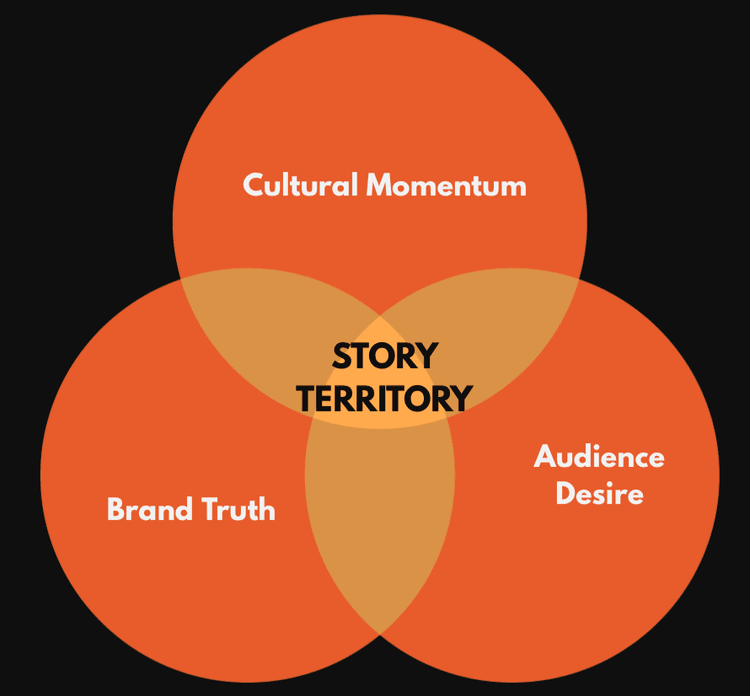
Finding your storyThe strongest shows live at the intersection of three forces: what your brand can speak to credibly, what your audience cares about, and what's happening in the broader culture.
|
|
Brand Truth is the authentic expertise or worldview your organisation can speak about without pretence. This isn't your product or your marketing messages. It's the real knowledge you've gained, the viewpoint you've formed, and the things you know better than most because of your daily work. A financial services firm might have expertise in how people actually make decisions about money, not just how they should make them. A logistics company might understand the hidden infrastructure that makes modern life possible. A healthcare organisation might see patterns in how patients navigate complex systems. Brand truth is what you know that others don't. It's the foundation of your credibility. Audience Desire is what your listeners care about emotionally or professionally. Their curiosity, ambition, challenges, and aspirations. This concept goes deeper than demographics or job titles. What keeps them up at night? What would make their work easier? What do they wish they understood better? Audience desire is not what your brand wants them to care about. It's what they actually care about, whether or not it connects to your product. In other words, the audience comes first, not you. Cultural Momentum is the broader conversation happening in the world that gives your story relevance right now. Technology shifts. Economic shifts. Social changes. Industries going through disruption. Questions being discussed in broader culture. Cultural momentum helps to create a sense of immediacy. It's why your show matters now, not just in general. The overlap is your story territory. It's narrow enough to own and wide enough to evolve. It's the ground where your show can credibly operate, where every episode feels like a natural extension of the same larger conversation.
|
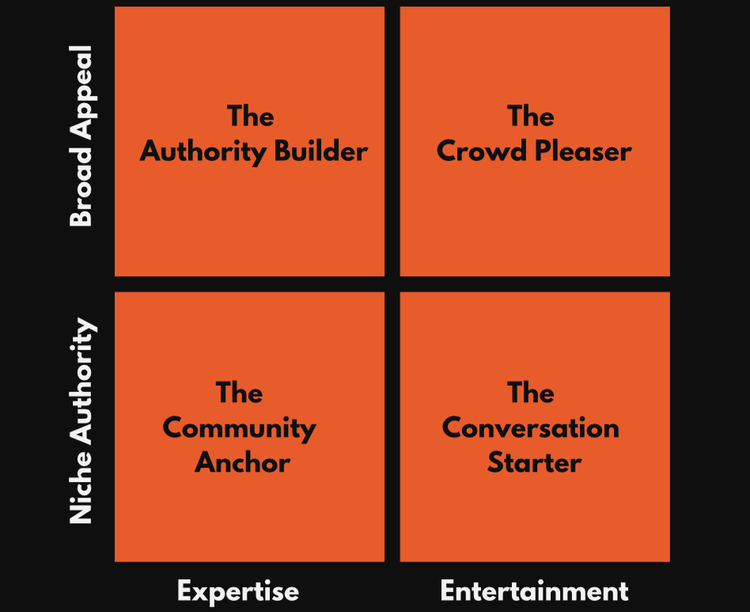
Positioning within the landscapeBefore committing to a concept, map the existing landscape. What shows already exist in your space? Where are they positioned? Where are the opportunities? A useful framework plots shows across two axes: The horizontal axis runs from 'Entertainment' to 'Expertise'. Some shows lean heavily on accessibility, personality, and a wide audience. Others place a premium on depth, technical precision, and specialised expertise. The vertical axis runs from 'Broad Appeal' to 'Niche Authority'. Certain productions strive for broad appeal, hoping to capture the attention of many different people. Meanwhile, some are designed to resonate deeply with a particular group of professionals. This creates four quadrants:
|
|
The Crowd Pleaser: Accessible, personality-driven shows designed to attract wide listenership. Strong for awareness, particularly effective when the host has an existing profile. The Authority Builder: Content that showcases expertise, yet still captivates those outside the field. It marries knowledge with narrative. This approach frequently hits the mark for brand podcasts aiming to build credibility while also attracting a wide audience. The Community Anchor: Deep, technical or peer-to-peer shows created for defined professional audiences. Strong peer respect and high retention within a specific community. The Conversation Starter: Smaller, personality-led shows that dig into niche topics. This strategy works well for giving a brand a human touch and establishing a genuine voice in new areas. Plot existing shows in your category. Identify clusters. Identify the open territory. The goal is to occupy a distinctive position where your storytelling voice is both credible and differentiated.
|
Concept modelsDifferent strategic intents call for different show structures. Four models cover most brand podcast concepts: Documentary Series: Multi-part exploration of a theme with field interviews and narrative voiceover. Strong for human-centric storytelling and emotional connection. Higher production investment is distinctive in a landscape dominated by interview shows. Investigative or Analytical Series: Each episode solves a question or breaks down a complex issue. Excellent for establishing thought leadership and building authority. It's particularly effective when your brand possesses authentic expertise to offer. Roundtable or Conversational: Multiple recurring voices offer diverse perspectives. Strong for community-building and advocacy. Lower production complexity but requires strong chemistry between participants. Hybrid: Combines narrative with interviews, field tape, or creative elements. Strong for brands seeking both accessibility and craft. Requires careful editorial design to maintain coherence. The right model depends on your strategic intent, your production capacity, and where you want to position the show in the landscape.
|
Strategic intent shapes creative decisionsEvery show benefits from clarity about its primary business intent. This isn't about measurement yet. It's about understanding why the show exists so that creative decisions stay aligned. Four strategic intents cover most brand podcast goals: Awareness: Build reach and familiarity among new audiences. Creative implication: big cultural themes, guest-driven storytelling, content designed for shareability. Authority: Strengthen position as a credible voice in the field. Creative implication: in-depth analysis, consistent editorial tone, expertise on display. Advocacy: Deepen trust and loyalty with key audiences. Creative implication: human-centred stories, a transparent tone, and content that builds affinity. Acquisition: Influence action, pipeline, or recruitment. Creative implication: case studies, product-aligned themes, clear pathways from content to action. Most shows have a primary intent and a secondary intent. Clarity about which is primary keeps creative decisions focused. When a guest pitch or episode idea comes up, you can test it against intent. Does this serve our primary goal? Does it fit within our defined territory?
|
Validating concepts before productionA well-designed show has a throughline. Something that connects every episode. A central question, a consistent perspective, a recurring theme. This isn't just a creative nicety. It's what makes an audience stick around. When listeners understand what your show is about, not just the topic but the angle, they know what to expect. They can anticipate value before they press play. That's how you build and keep your audience. The throughline comes from understanding your audience deeply enough to know what they consistently need, not just what might be interesting this week. But before you commit to production, pressure test your show concept against your audience. Can you describe the show in one sentence that would make your ideal listener want to subscribe? If you described it, would they immediately understand why it's for them? Can you sketch 20 episode ideas without running dry? Do those ideas connect through a whole series? Importantly, would the show survive if you removed your company name from it? Is it strong enough to stand alone? These are hard questions. They're meant to be. Better to wrestle with them in concept design than after you've recorded 10 episodes.
|
The pilot processBefore greenlighting a full season, produce a pilot episode or trailer that brings the concept to life. The pilot tests stories, flow, tone, and audience response in a low-stakes environment. Script or outline the first episode. Record a sample intro, key segment, and closing reflection. Share the pod internally and with a small external sample of the target audience. Collect both quantitative feedback (did people complete it?) and qualitative feedback (clarity, engagement, value). Refine concept, tone, and structure based on what you learn. The pilot phase validates creative direction while aligning internal stakeholders. It builds confidence that the show is ready for full production.
|
Show identityOnce the concept is validated, document the show's identity. This becomes the reference for every episode and every piece of derivative content. Tone and Voice: Define the style of the show. Authoritative, reflective, playful, empathetic. Document keywords that capture the voice. A useful prompt: "If this show were a person, how would it speak?" Title and Tagline: Should be about what the show delivers, not just what it's about. Keep it short, symbolic, and repeatable. A formula that works: Theme + Perspective. Sonic Identity: Opening and closing motifs, music beds, transitions, voice treatments. Sonic design should reflect the brand's personality. Warm, curious, precise, cinematic? Consistency in audio cues builds recognition as powerfully as a logo. Visual Identity: Podcast cover, motion titles, colour palette, typography, social clip templates. Align with brand guidelines but adapt for the intimacy of the medium. Simpler, bolder, closer. Capture all of this in a short Show Identity Guide or as part of the Show Bible. This document becomes the creative reference for the team, ensuring quality and consistency as the show scales.
|
What comes nextYou understand why podcasting builds trust differently. You know how to think about measurement. You've assessed whether your brand is ready. You know what it actually costs. You know how to design around your audience. Now you know how to develop a concept that positions you as a category leader. Next week: Format and Structure. How to build episode architecture that creates rhythm, maintains attention, and makes your show feel like a show rather than a collection of recordings.
|
|
|
|